



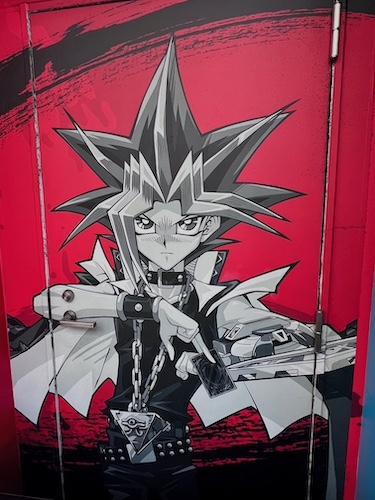

PAN reader and contributor Steve Bergson, a freelance content researcher/producer, has been to Japan recently and sent us this report exploring anime, manga and the threat of machine produced art.
Is AI calling the Toon?
That voracious style muncher, Japan’s manga industry, might now have discovered – to its horror – that it might itself have become tech’s lunch.
Japan – despite in some aspects having a reputation for strait laced social conservatism – is the nevertheless conversely also the home of weird fashions and new graphic trends. Its anime and manga industries are hugely important not just for the image of the country they project to the world but with a market value of a cool $25 billion, for the economy as well. However, having assimilated all kinds of global influences to create a unique marque, the business and art is now in mortal danger of being outmanoeuvred an all too familiar enemy, the fearsome El-el-em led by that dynamic frighteningly mortal foe, GenAI.
Artists at studios like Ghibli are now struggling with an issue that pivots on a philosophical puzzle. Technology has enabled the creation of iterations which are impressive but sail really close to outright plagiarism. The country’s Agency for Cultural Affairs in 2023 set out a stance on AI and copyright that established an intriguing benchmark where a close resemblance to a copyrighted work could still be legally deemed a violation. Meanwhile, the AI output itself could be regarded as uncopyrightable. Japan was trying to maintain an approach, a few degrees off the path the rest of the world was trying to follow, by promoting AI innovation which allows data training in LLMs while still maintaining protections against “direct” copyright infringement. Widely accused of being a form of fence-sitting, the policy sought a balance in midair, simultaneously trying to placate big tech while also protecting the indigenous creative economy.
The recent demise of OpenAI’s SORA has certainly indicated a vulnerability in GenAI, in its need to show a reasonable profit to match the eye watering development costs. Yet the manga industry is unable just to hunker down and sit out the digital data storm because it also faces challenges subtler than plagiarism…though equally dangerous.
Is the appetite for manga and anime declining? The readership numbers for a seminal magazine like Jump are down from the 90’s with only KoroKoro Comics, a manga magazine for young readers showing any growth. There is the inevitable shift away from print magazines to digital publishing apps with manga’s digital publishing sales overtaking print sales for the first time in 2020. Generations who grew up on magazine output have now become customers for upselling through apps but the future reader base could be falling away even though corporate revenue continues to climb. Whatever the vehicle for delivering the manga content, defenders of the move claim that forecasting the death of the genre might be simply ignoring its role as a primary form of children’s entertainment in short-form videos and anime.
The rise of digital publishing has coincided in Japan with the surprising surge of previously unfashionable Korean content. The manhwa industry – Korea’s equivalent to manga – had always been dwarfed by Japan’s manga publishing houses but in 2004 the launch of Naver Webtoon forged new styles of comic aimed primarily at a phone audience. The market was shifting in unexpected ways.
If the industry does morph entirely onto a digital platform, the opportunities for brand dilution and outright IP theft inevitably become more prevalent. As everywhere, the publishing world is coming to realise that digital is not the saviour of trade it might have at first appeared. But then such contradictions litter the battlefield terrain. When the Agency for Cultural Affairs announces it is developing an AI-backed system to help detect pirated material and issue automated takedown requests of infringements, it is still using AI to battle the onslaught of pirated manga. Katsuyoshi Kobayashi, the agency’s director of international copyrights promises the system will be rolled out at the end of 2007 It is a welcome government recognition of the scale of the problem. Japan’s content industry including anime, manga and video games contribute in 2024 in exports ¥6 trillion ($38 billion). This puts it on a par with the country’s semiconductor industry.
The loss, according to trade body, Authorized Books of Japan (ABJ), is very damaging. Large English translation piracy websites alone result in losses of around $800 million a month. The website Mangamura was making an estimated ¥300 billion worth of manga available free online until its closure in 2024, when the operator was ordered to pay ¥1.7 billion ($11.01 million) in damages to three major publishers. The graphic industry in Japan is still vibrant though it is wrestling with change which is possibly even more of a genuine existential challenge than in other parts of the economy. If it succeeds in reconciling the poles of AI that repel and attract innovation, then it will continue to be the fount of imaginative output that fuels so much animation as well as influencing other mainstream media like movies. And the artists still working and producing the work say they would of course much rather draw art themselves than generate it.
The invasive power of tech is as ever, more of a seep than an outright replacement. One reason why there is now a marked increase in elaborate manga drawings with no visible errors is the way the digital environment has made it easier to check for mistakes, but it is still human output. The reaction to Nintendo’s latest offering, a Star Fox revival, echoes the fierce arguments about nostalgia and modernising “iconic” characters like Wolf, Peppy and Slippy. Every redesign has of course now turned into a major cultural event, so any uncanny valley look in a design, which might run counter to the colourful more human vibe of classic games and almost delivers a film look, is met with a barrage of criticism from the customer base.
As the dust of battle settles, it is tempting to conclude that because there is a clash at all, an optimistic sign is coming into view. The context for all these sometimes abstract arguments is an increasing awareness of the importance of a constructive interface between machine precision and messy human creativity. Such a debate particularly shakes the manga and anime domain where it must give hope to a vital industry in Japan. In this it nevertheless has wider implications for creative output recoiling from the threat of machine produced art – all over the world.
Steve Bergson for PAN.