


PAN reader Steve Bergson visited the Berlin International Film Festival last week to attend a discussion panel and absorb the new films on review – he sent us this report of the festival and film review. – View Steve’s other industry reviews on PAN here.




The Lion in Winter
There’s a pointed caption in Austrian filmmaker Ruth Beckermann’s latest film that premiered at this years’s Berlinale, which muses: “telling stories differently means telling different stories”. It highlights the way a story unfolds – its perspective, structure, tone, and medium – can change the narrative itself, affecting its meaning and impact on the audience. We know all too well by now that truth is a very slippery concept. Fake news is a two way street….or at least, it should be.
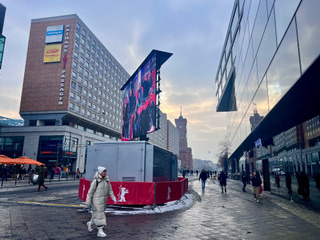
In a snowy frozen Berlinale festival, held in the German capital between the 12th and 22nd February, this axiom – truism even – reared its troublesome head many times. The event is noted for the enthusiastic interactivity between filmmakers and a very vocal audience, so a red flag was bound to flutter when President of the Jury, celebrated veteran German director, Wim Wenders, was asked by journalist Tilo Jung about the absence in the programme of anything to do with Gaza. Possibly mindful of offending the festival’s sponsors, which include the German government, Wenders countered with the opinion that movies need not always be political. He claimed “we are the counterweight of politics”, then adding “we have to do the work of people and not the work of politicians”. This defence of keeping quiet on an important issue offended many, including Indian author, Arundhati Roy who pulled out of attending with the words: “It is a way of shutting down a conversation about a crime against humanity even as it unfolds before us in real time – when artists, writers and filmmakers should be doing everything in their power to stop it.”. There was a widespread feeling that the notables on the jury were having to use their art as a cover against the criticism of those in power. Less constrained public figures like Javier Bardem, Tilda Swinton and Adam McKay felt impelled to condemn the festival’s “silence” on the issue of “genocide” in Gaza..
Much of the discussion going on in the city’s bars, at the Q & As and on the festival workshop panels focused on the vexed issue of authenticity and honesty which so often rubs up against the understandable desire to tell a compelling tale The relationship with truth was naturally a theme of Mark Cousins’ series about the history of documentary and the Silver Bear Grand Jury prize winner turned out to be Yellow Letters, a drama set in Turkey made by German director, İlker Çatak which Wenders described as chillingly showing the threat of repression “that could possibly happen in our countries”.
The quest for unbiased narrative is never ending, but it constantly seems compromised. Several drama productions like the Argentinian film Il Treno Fluvial seem to move between real elements like a recently closed local train service and dramatic constructions which shade into fantasy, or Truly Naked which depicts a very down-to-earth situation in a British seaside town but then explores the human reality of the effects of porn on its producers in a way impossible for a documentary to get near. It manages to transform its subject, from a superficial – even everyday – setting, to a subtly crafted and strongly emotional narrative.
In Wax & Gold, showing in the Special Gala section, the director Ruth Beckermann provides her own commentary on the exploration of a multi-layered past involving the former Emperor of Ethiopia, Hailé Selassié (1892–1975), who ruled his country for forty-four years. His reign might have seen the abolition of hand and foot amputations and the installation of electricity to modernise the country. However, Selassié was not necessarily the benign even holy presence his title, the Lion of Judah, given him by the Rastafarians in Jamaica, would imply. The building of the Addis Ababa Hilton Hotel in the 1960s, where mainly overseas business people have stayed, served by employees travelling in from far away in the country, is used as a totem of this legacy. The disquieting elements set out by Ryszard Kapuściński in his influential book The Emperor. This is referenced throughout the film even though the locals interviewed seem to know little about a work never translated into local language, Amharic.
This is evidently ironic since the wax and gold of the film’s title is the name of a local cultural strategy where words are expressed that sound exactly the opposite of what is actually meant – but put in such a way that the irony is obvious, the precious metal still visible in the wax. In observing the everyday life of the staff and guests in the hotel – business meetings, fashion shows, weddings, international conferences – the film looks to be trying to achieve this feat as well.
In terms of historical authenticity, telling the same story of the capital city from the perspective of the different individuals interviewed creates distinct narratives, which highlight the subjective nature of truth. The archive backs up these different viewpoints very effectively. It includes some fascinating clips of Richard Roundtree in a Shaft title (Shaft in Africa) and a scene in a 1943 Michael Curtiz film, Mission to Moscow, of Selassié played by Leigh Whipper, pleading with the League of Nations for help to defeat Italian fascism. This makes the film feel very like an exploratory essay. By tradition, the wax is not supposed to hide the gold; it actually moulds the metal it encloses. The wax, the land, the climate, even the different faiths in the society shape the gold which is the real treasure, the human capital of the Ethiopian people – both then and now.
Yet the feeling the audience gains here is of a quite superficial examination of this reality. The participants come out with unconventional observations about the sometimes dubious changes the city has seen and the role of outsiders in influencing its direction, but there is no clear thread through the past. The truth is of course not always visible, as the director admitted in her Q & A at one screening. Shifting from the first-person – even when you don’t see her, a white European – to third-person angles with multiple viewpoints – mostly from African people – naturally alters the our emotional closeness to the story. Instead of an authorial narration to steer our reaction, the collage is disturbing, particularly as it fails to crystallise into a picture that reveals the context of all these elements and interpretations. The narrative the film crafts only appears more nuanced. This is really epitomised by the opening shot in a film Beckermann provocatively captions, is not a documentary. This hits the audience with the disquieting view of a lion, you think might be dead, lying inside a cage in the former – now closed – Addis Ababa Zoo. The animal is actually resting on its back, sunning its belly while a zookeeper looks away, apparently disinterested. No real context is offered here though, so the interesting shot acts as a visual non sequitur – which could be illuminating if it were a bit less random. Here it stands out all too symbolically from the rest of the film which is nowhere near as quirky.
Perhaps ultimately this ambivalence is not so different from the position of the Berlinalle jurors. The festival’s US-born chief, Tricia Tuttle, at the awards ceremony, said she understood attendees who “arrived carrying a lot of grief and anger and some urgency about the world”.Inevitably the compromises involved in the making of the films presented in Berlin as well as the programme selections might nevertheless limit their impact. “And if this Berlinale has been emotionally charged, that’s not a failure of the Berlinale, and it’s not a failure of cinema,” Tuttle said. “That is the Berlinale doing its job, and it’s cinema doing its job.”
It all felt a bit like that lion on its back, leaping up to roar but only from within the confines of the cage. We see it but the zookeeper doesn’t
Original title: Wax & Gold
Directed by: Ruth Beckermann
Country/year: Austria, Italy /
Cinematography: Johannes Hammel
Produced by: Ruth Beckermann Filmproduktion, Citrullo International